On Saturday morning of October 4, 2025, South Skyline Emergency Preparedness Organization with some help from the SC4 Radio club ran the annual South Skyline regional emergency drill. This was an exercise to see if we could get every neighborhood to quickly contact all their residents and report back the results. It’s a good test of knowing who your neighbors are, proving you can find them, and testing your abilities to communicate in an emergency. The test yielded a good bit of data about what makes emergency communications successful.
The test has three phases:
- Phase 1: Preparation — Neighborhoods need to update their member directories, mailing and text lists, etc. This happens before the drill.
- Phase 2: At 10:30 on 10/4 each neighborhood tries to contact all their residents as fast as possible and get a check-in from them.
- Phase 3: Prior to noon on 10/4 each neighborhood has to contact the SSEPO communications trailer with counts of how many people were reached (X out of Y people). Afterwards there can be further follow-up reports as to how long it takes to reach everyone.
Results
Phase 2 — Neighborhood contacts:
- Monkey Rock: GMRS and email — 27 out of 27
- La Honda: email — 6 homes, 13 people
- Castanea Ridge: phone call — 20 people, 9 contacts; later another 3 out of 3 arrived by GMRS
- Rocky Creek: email — 52 out of 82 by noon; all 82 within 48 hours
- Middleton Tract: 17 out of 20 (not everyone participated in the drill)
- Portola Heights: GMRS — 41 out of 48 (not everyone participated in the drill)
Phase 3 — Reporting back to SSEPO:
- No text messages
- No ham radio messages
- 1 actual phone call from Castanea Ridge
- 3 GMRS messages
- 4 Winlink emails
Discussion
There is some sharp guidance from this drill for future drills:
- There’s a lot of change in our neighborhood every year. It’s critical to keep updating lists.
- It’s important to avoid a single point of failure. Many people need to be able to run the drill.
- If the internet is available, people use it. Notice that WinLink was the most common reporting mechanism.
- It’s important to count people, not houses. It’s people we want to make sure are safe!
- There are really two different scenarios: (1) Quickly reaching as many people as possible as fast as possible — “How many did you reach by noon?” This models delivering urgent news ASAP. (2) Eventually reaching everyone — for the case of sudden evacuations where it’s critical to deliver an accurate list of the genuinely missing or casualties. In future tests we should formally track these separately.
- It’s also important to differentiate “people who choose to participate” from “all people.” In real life we have to look out for everyone, no matter what their level of engagement is. The denominator is always ALL people.
- Each neighborhood can choose how they do this, however it’s obvious that to reach everyone requires using all available channels, not just the most comfortable ones.
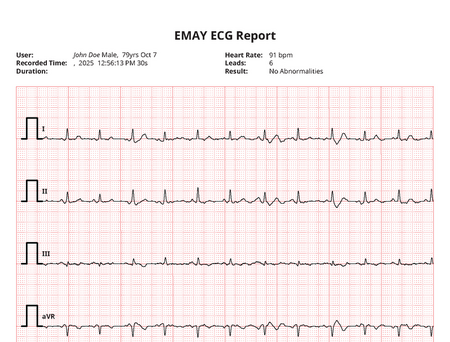
EKG Experiment
As a side note, an experiment was done to send EKG data over WinLink. This turns out to work very well. This is a good example of where WinLink has advantages over a plain radio link.