
PG&E’s electric service has become visibly less reliable over the past several years. Outages that used to be measured in hours now go on for days — or weeks for those with bad luck. These outages are regional in character, often affecting many residents simultaneously, and are frequently associated with widespread road closures and inclement weather.
Even off-grid neighborhoods are affected: extreme weather over longer periods can impact power supplies no matter what the choice of power source is.
These factors interact in ways that make extended outages harder than expected:
- Inclement weather reduces solar output
- Older solar systems shut off completely when the grid is down
- Long outages exceed what batteries alone can handle
- Closed roads prevent PG&E restoration, propane delivery, and fuel runs
- Large-scale outages cause propane shortages even when roads are open
Dealing With Power Outages
Know Your Power Consumption
Before planning your backup power, understand what you use. Look at your PG&E usage history — find your high-usage days (typically A/C, car charging, water pumping). Note that electric motors use double their normal current at startup, creating brief spikes.
Also consider reducing consumption: LED lighting, efficient appliances, optimized thermostat settings, and smart EV charging times all help regardless of outage planning.
Grid + Generator
The simplest backup for PG&E: a generator.
Key questions:
-
Does it need to come on automatically? If yes, you need a transfer switch — installed between PG&E service entry and your main panel. It detects outages, starts the generator, and switches back when PG&E returns. Switches typically cost under $1,000. PG&E sometimes offers programs to subsidize installation. A fully installed automatic system (generator + transfer switch) runs around $10K.
-
How much load do you need to back up? A separate subpanel for generator-backed loads helps. Otherwise, simply don’t run high-draw items (EV charger, A/C) while the generator is running.
Propane vs. gasoline: Propane is convenient but during regional winter outages, deliveries get backed up. Monitor your supply closely. Gasoline requires more frequent refueling. Small generators are usually gasoline-powered.
Important generator maintenance:
- Generators need regular exercise — run them weekly. Permanently installed generators do this automatically.
- A week of continuous operation equals roughly 5,000 miles on a car engine — that’s an oil change interval. Learn to do it yourself.
- Fuel consumption is roughly constant regardless of load — a well-sized house can use nearly $100/day of propane.
- Many generators produce “dirty” power that can damage electronics. Use UPS devices with “square wave output” to protect computers and sensitive gear, and to bridge the 5–10 second startup gap.
Summary: If you need automated, whole-house backup power, spend the $10K on a proper generator and transfer switch. If you have a small house and can live with partial manual backup, a portable generator is much cheaper — but requires discipline to manage and maintain.
Solar + Batteries
Traditional grid-tied solar (NEM-2 era) is completely useless during a power outage — the system shuts off to protect line workers. Batteries fix this: solar charges batteries during the day, and you run from batteries at night and during outages.
Battery considerations:
- Each battery unit costs $10K–$20K, and you’ll need more than one for extended outages.
- California has moved to NEM-3 for new installs, which drastically reduces what PG&E pays for solar exports. At this point batteries are a practical necessity to get a positive ROI on solar.
- In the mountains, solar panel placement is often constrained by trees, terrain, and roof orientation. Very bad weather can reduce output by 75%; wrong panel orientation reduces it 30–50%. Solar companies can overprovision panels to compensate, but this has limits. Again, batteries help with this issue significantly.
The full solution: Solar + Batteries + Generator
All four sources — solar, batteries, PG&E, generator — run through a single controller that optimizes between them. The generator only runs to recharge batteries as a last resort, saving significant fuel and maintenance. Modern systems like Franklin support this architecture.
Economics: A full system costs $90K–$100K installed, pays for itself in roughly 12–13 years, and provides a full return over 20–25 years. Battery technology is evolving rapidly — current systems may be technologically obsolete (though still functional) after 10 years.
Electric and Hybrid Vehicles
EV economics are complex in the mountains:
- EV energy costs are lower than gasoline if you charge at night or can charge from solar in the daytime.
- During long outages: charging from a generator is expensive. Better to charge just enough to reach public chargers in the valley.
- Gas stations also require electricity — in a widespread regional outage, refueling gasoline vehicles can also be difficult.
- Always have at least one vehicle you’re confident can get out.
The new generation of electric trucks (F-150 Lightning, Cybertruck) have large enough batteries to power your house for a period — if you have a bidirectional Level 2 charger and a compatible home energy controller. Many modern hybrid trucks come with large enough inverters to power a significant load as well. This has been proven effective in a number of incidents in the last few years.
Preventing Power Outages
Given that we live in a mountain area served by long power lines going through rough terrain, and we experience severe weather, of course there are power outages. But what if your neighborhood has been having a rash of power outages? More than would reasonably be expected? Are you not getting clear answers from PG&E? How can one escalate these kinds of problems with PG&E? How can one make the grid better for your neighborhood? If this is you, read on!
When your power goes out, the operations team dispatches a crew to go fix it. This process takes however long it takes. However frustrated you may be, the following is not about complaining or venting or wanting an ETA about the current outage.
This is about identifying systematic problems in the grid that if corrected would yield better service to your neighborhood. The people who worry about this are the “Distribution Planning” team at PG&E. Their whole job is to improve the state of the grid. Naturally, our grid is a target-rich environment. To get their attention you will need to be organized as a neighborhood and have a whole bunch of people complain all at once — the more the merrier! But don’t yell at them. This is about having an informed dialog, and working with them to come up with a solution. They absolutely will prioritize projects based on how many people are unhappy. And if enough people are unhappy, they’ll even schedule a neighborhood meeting in person.
Here’s how to initiate this process:
-
Call the outage line and request an outage report for your location. They’ll email you a PDF listing past outage causes — something like this:
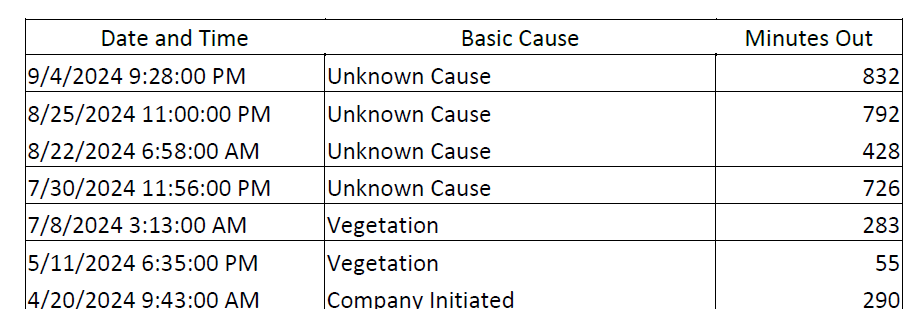
Don’t be surprised at how often they say “Unknown cause.” Cross-check this with your own records — it’s not always accurate. This will be a basis for further discussion.
-
Call again and ask to have a discussion about (a) what’s causing it, (b) what’s being done, and (c) how to make it better. Be firm about this — ask to speak to someone in Distribution Planning. It may take a few days, but you will get to speak to a real engineer: someone actually working on the problem, who knows the story and is completely honest about it. No PR flack! It’s often quite instructive to understand what they are doing. (For example, in one neighborhood there were so many outages that even the linemen themselves were complaining to this team about having to come out so often — there was significant internal pressure to address that problem.) Work towards identifying what steps could improve the situation. If this requires meaningful funding, having more neighbors speaking up helps prioritize it. The dialog will also help inform the neighborhood about what’s technically feasible, so you can ask for solutions that would actually work.
-
Coordinate with neighbors to call from multiple households. Volume of complaints directly affects PG&E’s prioritization. Collect facts, align viewpoints, and contact the call center from multiple directions.
One question that comes up is undergrounding the lines. This is not an answer in our area. Undergrounding costs $3 million per mile. PG&E is only contemplating this for high-voltage long-distance lines, and even there they can only afford 1% of the total per year. Most of our local outages are caused by secondary distribution lines, not the long-distance primary lines. PG&E has no intention of undergrounding secondary lines — instead, they mitigate fire risk using automated shutoff switches that cut power before a fire can start. This reduces fire risk but actually increases the number of outages.
That said, you can penetrate PG&E’s corporate mask and get through to real, informed human beings. These instructions let you speak to the engineering team — this won’t help if your concern is rates or business practices. It does take good neighborhood organization to be successful, and success ultimately depends on there being some identifiable and fundable solution. Your results may vary.